Then → Now · 2026
The conference has become a travelling fixture, reaching Sofia in 2024 and Paris in 2026, and its "work is an activity, not a place" thesis became ordinary office policy after 2020.
What it said (2017) ↓
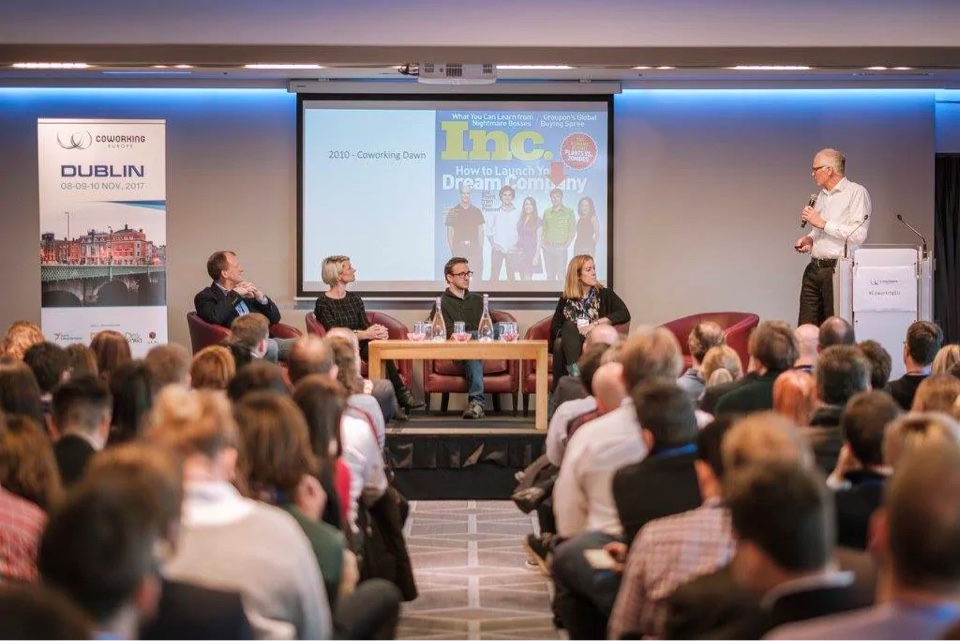
Coworking Europe 2017, Dublin, 400+ attendees.
Gitte Andersen (SIGNAL): work is shifting from a place to an activity; activity-based working; offices empty 77% of the time and desks 60%; "70% of millennials care less about salary".
What happened (2026) ↓
Coworking Europe went on to Amsterdam 2018, Warsaw 2019, virtual Vienna 2020–21, Amsterdam 2022, Porto 2023, Sofia 2024, Berlin 2025 and Paris 2026. The 2026 edition advertises 500+ attendees source.
"Work as an activity, not a place" became mainstream after 2020. Hotel groups also embedded coworking: Accor's Wojo has run coworking inside the group's hotels since 2018, according to Wikipedia source.
Verdict · Held up: 8 / 10 · Full 2026 update
- Work was shifting from a place to an activity, with offices moving to activity-based working.Came true
- Freelancers would make up 40% of the US workforce by 2020. depends on the definition (38% broad in 2023, 7.4% narrow)
- People launching a coworking space should talk to people first, delay spending and pre-sell memberships.Still valid evergreen
Original post · 22 December 2017
At the beginning of November, I travelled to Dublin to attend the Coworking Europe conference. I was extremely excited for many reasons. My very first Coworking Europe conference was the one in 2014 in Lisbon. Back in the day, I was a second-year Ph.D. student, researching – guess what – coworking spaces! This time I went as a professional, really knowing a lot about coworking spaces, but I was eager to learn more. They were 3 intense days, with more than 400 people gathered from all over the world to learn, share, and network. There were coworking founders, operators, community managers, consultants, investors, commercial real estate reps, and those who consider opening a space but had no idea how to. Well, they were just in the right place because we all had one thing in common: being passionate about the coworking industry. I was excited to see that two of my favourite topics were on the agenda: "coworking and big companies" and "the practical steps to follow when you open your very first space". I'm happy to share the main takeaways for everyone who couldn't attend the event.Big Companies & The Coworking Industry
Why are companies interested in optimising their current office environments in a way that boosts innovation? And what models are out there to help them prepare for the future? Gitte Andersen, founder and Global Head of Workspace Management & Design of SIGNAL, summarised the major global trends that influence companies’ strategy-making processes when it comes to attracting qualified employees, enhance collaboration, optimise space utilization, and increase workforce productivity, that in turn boosts innovation:- Perception of work is changing: from work as a place to work as an activity
- Types of workplace environments are changing: from several persons’ office to activity-based working environments where no employee ‘owns’ or has an allocated workstation, instead, the workspace provides employees with a variety of pre-arranged activity areas and free choices in order to undertake specific tasks during the day
- Types of cooperation is changing: today we talk about mutual cooperation with an increased focus on connectivity and diversity as a foundation for innovation
- Office spaces are often underused: offices are empty 77% of time and desks are empty 60% of time
- Collaboration as a competitive power: the more we share on m2, the more facilities are in the same place, so we support more on collaboration. And collaboration is a competitive power because when people collaborate, they use less m2, work 15% faster on average, 75% better, and feel 60% more innovative and 56% more satisfied
- Employee trends: people are looking for a workspace that is collaborative, mindful, ageless and intuitive. Employees are also entrepreneurs with an increased focus on work-life balance. They require support, and time and space to work on their passion projects.
- New generation on the labour market: 70% of millennials care less about salary but more about a workspace that supports collaboration, well-being, and is engaging.
- Growing number of freelancers: for instance, they will make up 40% of the US workforce by 2020. They want to be their own boss.
Takeaways For Aspiring Coworking Space Owners
What not to forget when opening up your very first coworking space? Tony Bacigalupo, who helps people start and grow thriving collaborative communities through New Work Cities, hosted a session and provided a handful of good tips for anyone who is looking to open a coworking space. Some of his extremely helpful advise included:- Before launch, talk to people, find out what they need and proceed accordingly.
- Don’t spend money as long as you don’t have to. I.e. for space options, there are cafés or your home where you can start building your community.
- Don’t do it alone, do it with friends or former fellows you trust in.
- If you don’t have the money, don’t stress. There are many financing options are available, such as sponsorship, personal loans, crowdfunding, and membership pre-payments that help you get the money you need.
- For attracting people: start with those who you don’t have to fully explain what coworking means. Those who are more or less familiar with coworking, have some understanding, so it is much easier to attract. For newbies: invite them to happy hours, help them to get the feel what coworking is about, create opportunities where they have a chance to talk to those who know what it is about.
- Good ideas can wait. For sure you have loads but remember, don’t try to make them all happen at once! Instead, create lots of supporters and build emotional connections with people who will be happy to help you along the way.
- Don’t forget to savor what you do - enjoy enjoy! And gather a big opening party!
Final thoughts
This year many more interesting topics were covered and there were more lessons to be learned. I enjoyed talking to old friends, making new friends, getting inspiration from peer-lead unconference sessions, and learning about new approaches to create more meaningful connections and experiences in coworking spaces. Thanks to the organisers and attendees to make this event such an invaluable experience! See you all next year!What happened after this was written
Claims then:
- Coworking Europe 2017, Dublin, 400+ attendees.
- Gitte Andersen (SIGNAL): work is shifting from a place to an activity; activity-based working; offices empty 77% of the time and desks 60%; "70% of millennials care less about salary".
- Freelancers "will make up 40% of the US workforce by 2020".
- Companies' options: activity-based offices, links with coworking spaces, "the city as a workplace".
- Tony Bacigalupo's launch tips: talk to people first, don't spend money before you have to, pre-sell memberships.
What happened since:
- Coworking Europe went on to Amsterdam 2018, Warsaw 2019, virtual Vienna 2020–21, Amsterdam 2022, Porto 2023, Sofia 2024, Berlin 2025 and Paris 2026. The 2026 edition advertises 500+ attendees source.
- "Work as an activity, not a place" became mainstream after 2020. Hotel groups also embedded coworking: Accor's Wojo has run coworking inside the group's hotels since 2018, according to Wikipedia source. A hard figure for corporate adoption of coworking was not gathered in this pass.
- The "40% freelancers by 2020" forecast depends on the definition: Upwork's broad survey put freelancers at 38% of the US workforce in 2023, while BLS counts independent contractors as their main job at 7.4% (July 2023). BLS
Named spaces/orgs status:
| Name | Then | Now | Evidence |
|---|---|---|---|
| Coworking Europe | 400+ attendees, Dublin | 500+ advertised, Paris 2026 | official |
| New Work Cities (Tony Bacigalupo) | Coworking launch coaching | "Social infrastructure for cities" | site |
Verdict: Came true (activity-based and hybrid work). The 40% freelancer forecast depends on the definition (38% broad in 2023, 7.4% narrow). Still valid (evergreen) (the launch tips).
Headline finding: The conference has become a travelling fixture, reaching Sofia in 2024 and Paris in 2026, and its "work is an activity, not a place" thesis became ordinary office policy after 2020.
Re-verified 3 November 2026: 3 claims confirmed, 1 corrected, 1 hedged, 0 removed.
Researched 30 September 2026 and re-verified against the sources on 3 November 2026. Sources are linked in each point. Items marked "unverified" could not be established and are not guessed.