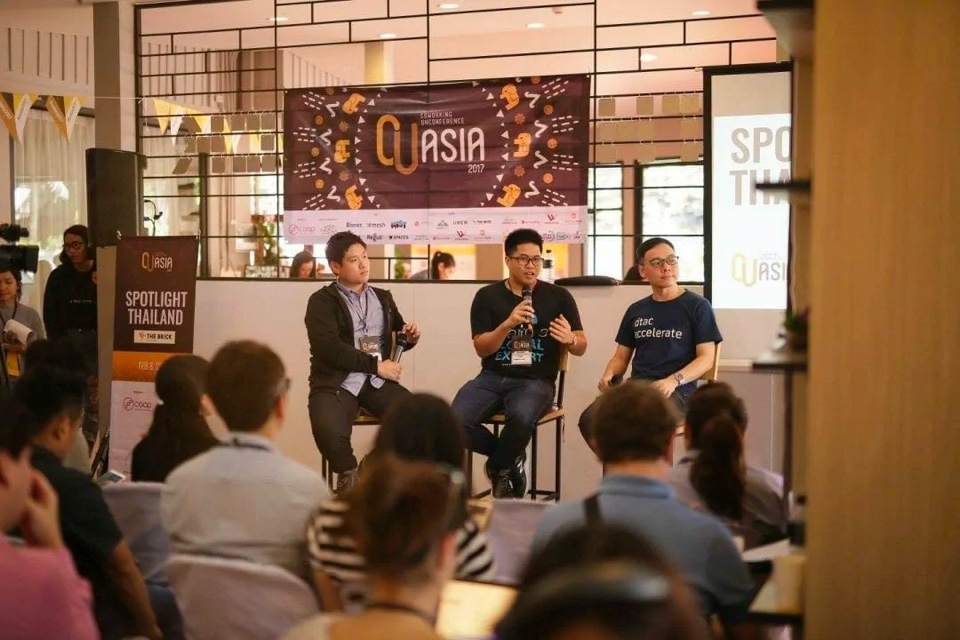
We called it one of the biggest yearly coworking events in the world; here is what it taught us, and what became of it and its host.
Coworking Unconference Asia, CU Asia for short, turns up twice in our 2018 archive. In January we published a preview built on three people's memories of the 2017 event. In March, after the team got back from Penang, Malaysia, Anita Fuzi wrote a reflection on the talk she gave there.
This piece puts the two together and adds what we know now. The short version: the lessons held up better than the event did.
What we said about it
We described CU Asia as "one of the biggest yearly coworking events in the world": a 5-day programme of workshops, discussion, excursions and time with people who thought hard about coworking. People flew in from all over the world, and many came back the following year.
The preview talked to three of them, all first-timers in 2017 and all going back in 2018:
- Uwe Allgäuer, co-founder of Coworking Bansko in Bulgaria, remembered how well it was organised and how open people were with their stories. "It felt like visiting friends." His main takeaway was that coworking could include a lot more than he had first thought.
- Brittnee Bond, a coworking consultant, loved the mix of the local entrepreneurship scene and the global coworking one. The unconference part was her favourite, and "even just the networking alone made it worth it".
- Serkan Kurtulus, our founder, was struck by the positivity and the amount of hands-on sharing. His takeaway was that coworking is "one BIG inspiring and collaborative community" that everyone in it should give back to. He was impressed enough that Cowork7x24 became a gold sponsor for 2018.
A small footnote that says a lot about the event: Madison Hanna joined our team after meeting Serkan at CU Asia 2017.
The lesson from Penang that still stands
Anita's talk at the 2018 Coworking Academy was the most useful thing we brought home. Her research, carried out between 2013 and 2016 with coworking spaces in Wales, asked what first attracts people who have never coworked before.
The answer surprised a room that believed coworking is all about community. The top attractor was the appealing physical environment, including good office infrastructure: 62% of respondents (N=89).
Her point was not that community doesn't matter. It was that design and layout are what newcomers can see and will pay for. Once they are in, they discover the atmosphere and the people, and that is what keeps them. We still think that is a healthy correction to the "community is everything" line.
She paired it with Ashley Proctor's steps for building a community, which she illustrated with stories from the Welsh spaces she studied:
- Know your market and your members.
- Build a supportive team, with a host who connects people (one of Anita's Welsh operators called it being "a linker with people").
- Build your community before the space.
- Involve members in important decisions, and listen to them.
- Don't be afraid to curate the community.
- Animate it with member events.
- Invite people in to experience it.
One correction to the old post: it introduced Ashley Proctor as being "from Coworking Toronto" as if that were a single space. Coworking Toronto is a collective of spaces, not a single space. She is described as one of its founding members and as the founding executive director of Coworking Canada.
Anita closed with: "community building is an ongoing process – it never ends, but it gets easier over time." That one we would not change a word of.
What happened next
Anita also told readers to come to the next CU Asia in Goa, India. That one came true: CU Asia 2019 was held in Goa.
After that the story gets shorter:
- Bali, March 2020. CU Asia ran in Bali in early March 2020 (Coworking Academy from 2 March, the main event 5–7 March), just before the pandemic, with Renee Martyna, whom Cobot calls a co-founder of both Hubud and CU Asia, among the people behind it (Cobot, Remoters). It was the last full edition we can find.
- 2021: cancelled. (Remoters)
- Fukuoka, October 2024. The name came back in a smaller form: "Digital Nomad Summit 2024 with CU Asia", on 24–25 October in Fukuoka, Japan, as part of the city's Colive Fukuoka 2024 digital-nomad programme (Japan Digital Nomad Association, PR Times).
- 2025 and 2026. We found no edition.
The host's story runs alongside it. Hubud, the Ubud space behind CU Asia, merged into Dojo Bali on 1 March 2019. Hubud's website still reads "Sorry Hubud is closed due to COVID-19 until further notice". Dojo Bali closed in December 2022.
Better news from one of our interviewees: Coworking Bansko is still operating.
Looking back
We were right that CU Asia was special, and right that people kept coming back. We didn't see that a format built on flying people across the world for five days would be the first thing a pandemic took away.
What we would keep from those years is not the event but what people carried home from it. Show newcomers a space worth walking into. Then give them a community worth staying for. And keep at it, because it gets easier over time.
Anita's post ended with a thank-you to the team that made the 2018 event happen. We'll repeat it: thank you, Hubud.
Written 3 November 2026 from the research behind the archive's 2026 updates (checked 30 September, re-verified 3 November 2026). Sources are linked in the text.