Two trips to CoworkingNow in Gdańsk, a pile of survey numbers, and what they look like seven years later.
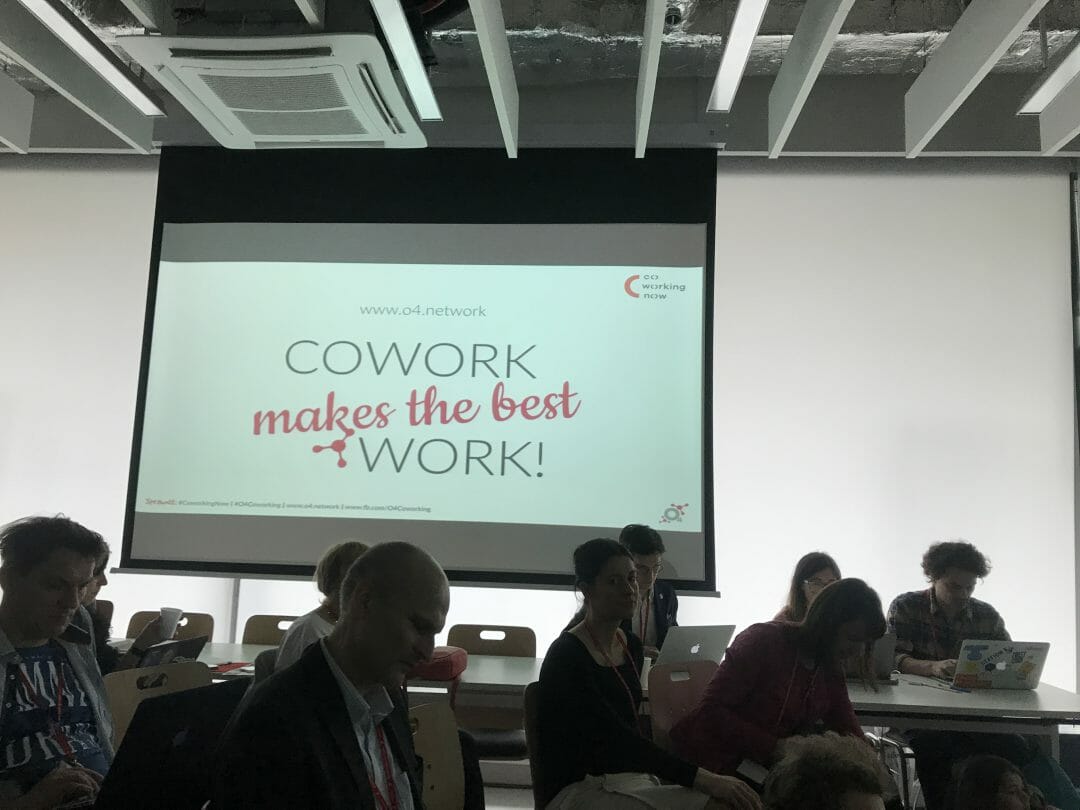
In 2019 our founder Serkan went to CoworkingNow, Poland's coworking (un)conference in Gdańsk, for the second year running. He wrote about it twice: a preview in March and a recap in April.
Both posts lean on numbers from 2018 and 2019. Those numbers were a fair snapshot then. They are not a description of Poland now. So this piece keeps the ideas, labels the data with its date, and checks the predictions.
The setting
CoworkingNow was run by O4 Coworking in Gdańsk. The 2018 edition had 20 speakers from around the world and about 100 participants over two days. The 2019 edition was the third.
Serkan's argument for going was that every country has its own take on coworking, shaped by local business, culture and expectations. He had visited over 250 spaces in Europe and Asia in three years, and that was the one lesson that held without exception. So local conferences made sense, and "every country/region has started to hold one of their own".
What people said on stage
A few lines from the two years stand up well:
- Pick a partner, not just an investor (Mike LaRosa, 2018). An investor brings cash and high profit expectations. A good partner brings support for the space you actually want to build.
- Coworking is people (Claire Carpenter, 2018). Not an office, coffee and wifi, but people who want to connect and build businesses together.
- Stand out or die (Pauline Roussel, 2018). The diversity of spaces is the industry's strength.
- Fix your basics before you buy software. A point Serkan strongly endorsed: automating a broken process just amplifies the problem. The same goes for social media.
- Sisu (Beata Stramska, Nord HR, 2019). The Finnish idea of perseverance in a task that looks almost hopeless. Serkan thought it described running a coworking business perfectly.
And the most practical list of the lot, from Beatrix, co-founder of Impact Hub Budapest, in 2019. Her five drivers of a financially sustainable coworking space:
- A diverse community
- Location
- Curated content for the community
- Financial reporting in place
- Readiness to change and adapt
We'd hand that checklist to anyone opening a space today. Impact Hub Budapest itself is still operating, now at Babér utca 1–5 (Impact Hub Budapest).
The numbers, with their dates on
Both posts quoted O4's research on the Polish market. Read these as 2018 figures, drawn from the spaces and coworkers that answered O4's surveys, not as a census and not as today's market.
From O4's report with the Infuture Institute, comparing 2018 with 2017:
- 70% of responding spaces had more members than the year before.
- 50% had added desks or office area.
- 60% recorded higher profits than in 2017; 10% said 2018 was worse.
- 81% had been open for more than two years, 13 points up on 2017.
- Their plans: 53% wanted to improve their financials, 47% wanted more members, 26% planned another location, 23% planned more services.
From an O4 survey of the Polish coworking scene, presented at the 2018 conference: 66% said fewer than 30% of the people in their space were women. Serkan's comment then still applies: there was "absolutely room for improvement in diversity".
And one figure of our own: our research at the time counted 140+ reported coworking spaces in Warsaw alone. We can't tell you the count today, or how full those spaces are, so we won't guess.
What we predicted, and how it went
"Every country will hold its own conference": came true, as far as we can tell. Coworking conferences kept travelling: Coworking Europe chose Warsaw in 2019 and Sofia in 2024.
"Can't wait to go back for the next CoworkingNow": there wasn't one we can find. We found no edition after the third one in April 2019. Its old web address now carries unrelated filler text about coworking in France and a "Stay tuned for more informations" line; the only date on it is a 2020 copyright footer. That's the absence of evidence, not a confirmed ending, but it is where things stand.
"We are the early adopters of an industry that is yet forming": came true, in a way we didn't expect. The industry did form. It just formed around the word "flex". Coworking Europe now calls itself "the voice of Europe's flex and serviced workspace industry", and hotel groups run flex brands.
"Serviced offices are a different business, not coworking": the line got blurry. In 2019 the room agreed that serviced offices are a fine business, but if you want coworking, community has to be at the centre. Today O4, the host of that conversation, is still operating at Olivia Centre in Gdańsk. Its site now leads with serviced offices, then coworking, conference rooms and virtual offices, and calls itself "the largest business community in the Tricity".
We don't read that as a contradiction so much as an answer. Beatrix's fifth driver was readiness to change and adapt. O4 is still here.
Global players, empty spaces, boutique spaces and a start-up scene serving coworking: unchecked. We predicted big operators entering Poland, a risk of empty spaces, a good future for small spaces with a real community, and new start-ups serving coworking. We don't have the evidence to score these, so we'll leave them open.
Looking back
2018 and 2019 felt like Poland's coworking moment, and the numbers from those years back that up for the spaces that answered. The conference that captured it is quiet now. The ideas it put on stage, from sisu to the five drivers, are the part worth keeping.
Written 3 November 2026 from the research behind the archive's 2026 updates (checked 30 September, re-verified 3 November 2026). Sources are linked in the text.